Author: tstadmin

  • Fish slaughtered (Newsletter from Open Philanthropy Project)

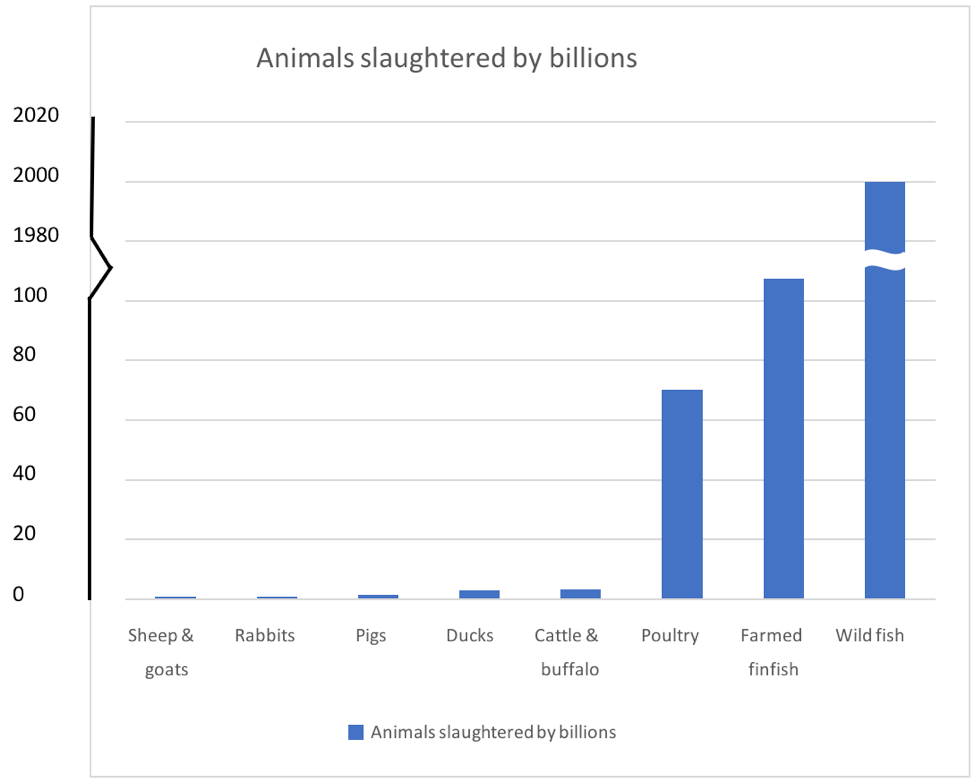
    There has historically been almost no effort made to reduce the inhumaneness of fish slaughter. The majority of fish are killed without stunning, by asphyxiation either in the air or on the ice. One study found that it takes common species of fish 55-250 minutes to die via asphyxiation. Fish that aren’t asphyxiated often die by being live gutted; the same study found that live gutting can take up to 25-65 minutes to kill the fish. Fish who are stunned are typically struck on the head (percussive stunning), stunned electrically, or stunned using gas. Pre-slaughter stunning is more common in wealthier nations (like the UK, Northern Europe, Chile, Canada, and Australia) and for high-value species (like salmon and trout).
    Read more

  • Dimensions of suicide: perceptions of lethality, time, and agony

    Two hundred ninety-one lay persons and 10 forensic pathologists rated the lethality, time, and agony for 28 methods of suicide for 4117 cases of completed suicide in Los Angeles County in the period 1988-1991. Whereas pathologists provided consistent ratings, lay persons demonstrated extreme variability and a tendency to inflate ratings of all three dimensions. Significant gender differences emerged, with females rating frequently used suicide methods more similarly to pathologists than the males did. Males who suicided used the most lethal and quickest methods whereas females selected methods varying in lethality, duration, and agony. African Americans were overrepresented in the use of the most lethal and quickest methods.

    Read more

  • Preparatory notes for an Algometry

    Measurement and estimation are of prime importance for most rational activities dealing with suffering, and quantitative studies concerning suffering should be developed as an independent subdiscipline, which could be called algometry.

    Read more

  • Empathetic feedback was able to reduce pain intensity perception

    Empathetic verbal feedback from others has been shown to alleviate the intensity of experimental pain on an experiment on pain perception and empathy in humans.

    In the experiment they created a dedicated setup mimicking a medical environment where people enduring painful stimuli received empathetic or unempathetic comments from others. Positive (empathetic) feedback was able to reduce pain intensity perception, in agreement with previous theoretical models and experimental studies, while negative (unempathetic) feedback did not induce consistent changes in pain intensity reports.

    Read more

  • A pain cream with no active ingredients worked even when not used

    Placebos are so effective that placebo placebos work: A pain cream with no active ingredients worked even when not used by the patient. Just owning the cream was enough to reduce pain.

    Read more

  • A map of hypotheses related to consciousness, sentience and identity

    The following map tries to present in a global way some of the theories and approaches on sentience / consciousness / identity, and in general, on reality, grouped into four large groups: GOD, PARTICLE, EMERGENCY and MATRIX. The enumeration is not exhaustive and several of these theories could be classified in more than one group at a time.

    Read more

  • How to address the problem of sentience?

    In the field of philosophical ideas we can not (easily) make predictions, but we can prove and demand that philosophical hypotheses should have:

    • Regarding the proposed subject:
      • Clarity
      • Internal coherence
      • Compatibility with the evidence (observations, experiences)
      • Explanatory capacity
      • Parsimony, in the sense of leaving out accessory or arbitrary elements
    • Regarding the author, the creation process, and its context:
      • Honesty
      • Impartiality
      • Skepticism
      • Recognize the intention
      • Recognize the motivation

    Read more

  • Asymmetries and compensations between pleasure and pain

    There are two very related questions: “Is there a symmetry between suffering and enjoyment?” and “Can suffering be compensated with enjoyment?”

    Investigating the way in which we respond to these questions is very relevant, since we may have biases or blindness that are encouraging to make bad decisions, such as the survivorship bias. By better understanding and evaluating suffering and enjoyment we can more easily minimize suffering and maximize enjoyment, as well as compensate for bad experiences, if such a thing were possible.

    Read more